
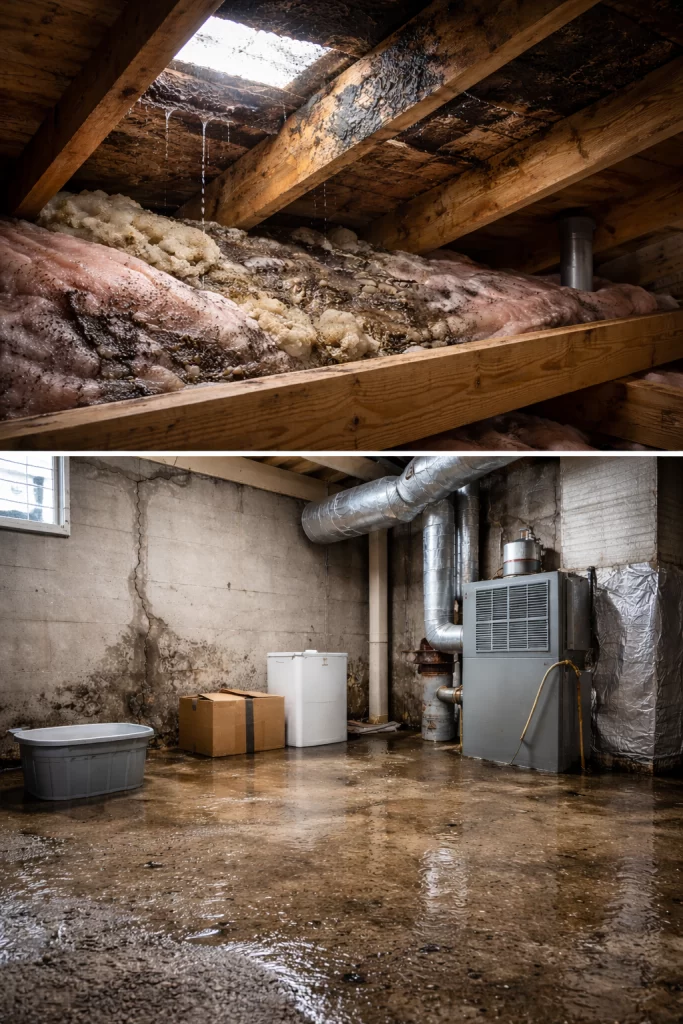
Mold and water damage are common problems caused by rain, snow, and melting ice in many homes. Water damage and mold growth do not always begin with obvious flooding or dramatic roof failures. In many New Jersey homes, moisture problems develop gradually due to prolonged rain, melting snow, ice buildup, and repeated freeze-thaw cycles. These weather conditions most commonly impact attics and basements—two areas that are often out of sight but critically important to a home’s structure and indoor air quality.
Throughout Monmouth County and surrounding areas, homeowners are increasingly discovering that seasonal moisture intrusion can quietly damage insulation, framing, and finished materials long before visible warning signs appear. When moisture remains trapped, it creates ideal conditions for mold growth and can affect the entire home through natural airflow and HVAC circulation.
How Rainwater Intrusion Leads to Attic Mold and Structural Damage
Attics are one of the most common locations for hidden water damage caused by rain. Even small roofing defects can allow water to enter and spread across roof decking and framing without immediately staining ceilings or walls.
Rainwater commonly enters attics through:
- Missing or deteriorated shingles
- Failed flashing around chimneys, vents, and roof penetrations
- Cracked or aging vent boots
- Worn roof underlayment
- Clogged gutters that force water beneath roof edges
Once water enters the attic, it often travels horizontally along rafters and roof sheathing rather than dripping straight down. Insulation absorbs and holds moisture, slowing the drying process and keeping surrounding wood components damp. Over time, this can lead to mold growth on roof decking, trusses, and framing, as well as reduced insulation performance and structural deterioration.
Why Snow and Ice Create Serious Attic Moisture Problems
Snow and ice introduce a more persistent form of attic moisture damage, especially during New Jersey winters. Warm air from the living space naturally rises into the attic. If insulation or ventilation is insufficient, heat warms portions of the roof, causing snow to melt unevenly.
As meltwater reaches colder roof edges, it refreezes and forms ice dams. These ice dams trap water and force it back underneath shingles and roofing materials, allowing moisture to enter the attic structure. This process can repeat continuously throughout winter, keeping insulation and wood framing damp for extended periods.
Ice dam-related moisture often leads to:
- Chronic attic dampness
- Mold growth on rafters and roof sheathing
- Wet or compressed insulation
- Hidden ceiling damage below
Because this damage develops slowly, mold can spread extensively before homeowners realize there is an issue.
Condensation: A Common and Overlooked Source of Attic Mold
Not all attic mold is caused by roof leaks. Condensation is one of the most common contributors to attic moisture problems, particularly during colder months.
Everyday household activities such as cooking, showering, laundry, and even breathing release moisture into the air. That warm, moisture-laden air rises and enters the attic. When it contacts cold surfaces like roof decking, nails, and framing, condensation forms.
Factors that increase attic condensation include:
- Bathroom or kitchen exhaust fans venting into the attic
- Blocked or inadequate soffit and ridge ventilation
- Air leaks around attic hatches and recessed lighting
- Inadequate or compressed insulation
Repeated condensation keeps wood and fasteners damp, creating conditions that allow mold to grow even without an active roof leak.
How Water Seepage Through Foundations Affects Basements
Basements are vulnerable to moisture intrusion from below and from the sides. Heavy rain and melting snow saturate the soil surrounding a home’s foundation, increasing hydrostatic pressure against foundation walls and slabs.
Water can enter basements through:
- Hairline cracks in foundation walls or floors
- Porous concrete or masonry block
- Gaps around utility penetrations
- Window wells below grade
- Overwhelmed or poorly functioning drainage systems
Even minor or intermittent seepage can keep basement areas persistently damp, which is enough to support mold growth over time.
Why Finished Basements Carry a Higher Mold Risk
Finished basements significantly increase the risk of hidden mold damage because moisture becomes trapped behind finished materials. Drywall, flooring, insulation, and framing conceal water intrusion until mold growth becomes widespread.
Finished basements often include:
- Drywall and wood framing
- Carpet, laminate, or vinyl flooring
- Drop ceilings and soffits
- Furniture and stored belongings
Once moisture penetrates these materials, mold can grow undetected for long periods, often resulting in more extensive remediation when discovered.
How Basement Moisture Can Impact HVAC Systems and Air Quality
Many homes have HVAC air handlers, ductwork, or return vents located in the basement. When moisture or mold is present, HVAC systems can draw in basement air and circulate it throughout the home.
Basement moisture can contribute to:
- Mold growth inside ductwork
- Contaminated air returns
- Corrosion of HVAC components
- Reduced system efficiency
- Potential distribution of airborne mold spores
In homes with finished basements and shared air circulation, a localized moisture issue can affect air quality throughout the entire house.
The Stack Effect: Why Attics and Basements Are Connected
Attics and basements are connected by a natural airflow pattern known as the stack effect. Warm air rises and exits through the upper portions of the home, pulling air upward from lower levels to replace it.
Because of this airflow:
- Basement moisture and odors can move upward
- Attic air issues can influence living spaces
- Mold spores can circulate throughout the structure
Addressing only one area without evaluating the other often allows moisture problems to persist.
Why Mold Thrives in Attics and Basements
Mold requires moisture, organic material, and time. Attics and basements provide all three. Cold temperatures slow evaporation, poor ventilation traps moisture, and hidden cavities allow mold to spread unnoticed.
If left untreated, mold can:
- Damage structural materials
- Reduce insulation effectiveness
- Affect HVAC operation
- Degrade indoor air quality
- Lower property value
Professional Assessment Matters
Water damage and mold growth are rarely limited to visible surfaces. Moisture often spreads behind walls, under flooring, and through insulation. A proper assessment identifies moisture sources, affected materials, and the full extent of contamination so the problem can be addressed correctly.
United Marvel Restoration is a family-owned mold remediation and water damage restoration company based in Monmouth County, New Jersey. We specialize in identifying and addressing moisture intrusion related to rain, snow, ice dams, and foundation seepage, with a focus on attics, basements, crawlspaces, and HVAC-adjacent areas.
Our approach emphasizes proper evaluation, clear communication, and remediation methods designed to correct moisture conditions and prevent recurrence.
More information about our services can be found at
www.unitedmarvelrestoration.com
Final Thoughts
Rain, snow, and melting ice create powerful moisture forces that affect both attics and basements. When water enters from above through the roof or from below through the foundation, it can lead to mold growth, material damage, and indoor air quality concerns that impact the entire home.
Homes with finished basements and basement-based HVAC systems face increased risk, especially when moisture remains hidden behind walls or within insulation. Early detection, proper moisture control, and professional remediation are essential to protecting both the structure of the home and the health of those living inside it.